


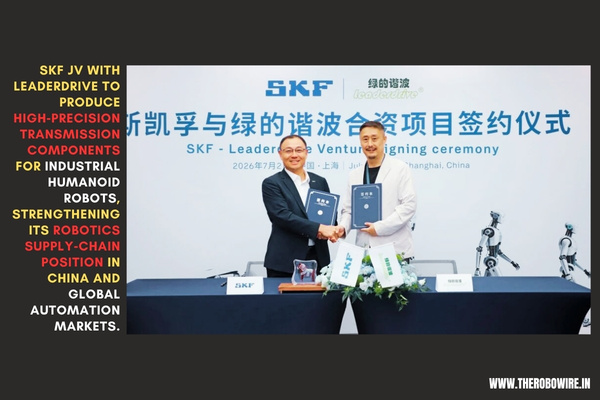
SKF is stepping up its game in humanoid robotics with a new joint venture in China alongside Leaderdrive, a local specialist in precision robotic components. The partnership will focus on high?precision parts for robot joints, putting SKF closer to fast?growing robotics supply chains and industrial customers in China and other global markets.
SKF steps into humanoid robotics
SKF, the Swedish industrial giant best known for its bearings, has signed an agreement with Leaderdrive to create a new venture in China dedicated to transmission components for robot joints.
These parts are designed for movable joints in industrial humanoid robots rather than consumer?grade machines, reflecting the growing demand for robust, factory?ready humanoid systems.
SKF will hold a 60 percent stake in the new company, giving it majority control while tapping into Leaderdrive’s experience in humanoid and automation applications.
The venture is expected to be up and running toward the end of 2026, timed with the anticipated ramp?up in embodied AI humanoids across manufacturing and logistics operations.
Why SKF chose Leaderdrive and China
Leaderdrive has built a reputation as a specialist in precision robotic components, including strain wave reducers that are essential for accurate, repeatable motion in robot joints.
By pairing Leaderdrive’s niche expertise with SKF’s bearing technology, scalable manufacturing and global reach, the partners aim to shorten time to market for high?precision joint assemblies tailored to humanoid robots.
Setting up the venture in China places engineering and production at the heart of major robotics supply chains and some of the fastest?growing markets for humanoid systems.
While the new company will be based and producing in China, SKF plans to use its existing sales network to serve customers across Europe, Japan and the United States as industrial humanoid adoption gathers pace.
Focus on embodied AI humanoids
The joint venture will concentrate on components for industrial humanoid robots powered by embodied AI, a segment attracting increasing investment from automation and electronics players.
These humanoids are built for continuous operation in environments like factories and warehouses, where reliability and performance of key transmission components are critical.
High?precision parts for arms, legs and other joints must withstand demanding duty cycles while maintaining accuracy and uptime. That plays directly to SKF’s strengths in durability and harsh?environment performance.
Leaderdrive’s experience in humanoid robot applications complements this by tuning components to the specific motion profiles and load conditions of next?generation embodied AI platforms.
Strategic fit with SKF’s growth agenda
SKF sees the venture as a natural extension of its strategy to focus on industrial segments with strong growth potential, including robotics and advanced automation.
Holding a majority stake gives SKF a meaningful foothold in an emerging humanoid robot supply chain rather than leaving it as a general?purpose component supplier.
The partnership also gives SKF room to adapt as robotics demand and technology evolve, while continuing to leverage its core technologies and manufacturing capabilities.
As embodied AI humanoids shift from pilots to large?scale deployments, secure access to reliable joint components could become a significant competitive advantage for both robot manufacturers and their suppliers.
Impact on robotics and industrial automation
For the broader robotics sector, the SKF-Leaderdrive venture underscores how established industrial suppliers are moving toward dedicated hardware platforms for humanoid robots.
 Purpose?built joint assemblies can help robot makers boost performance, streamline integration and reduce engineering overhead while hitting industrial reliability targets.
For manufacturers, wider availability of standardized, high?precision components may lower the practical and financial barriers to bringing humanoid robots onto production lines and into logistics hubs.
With operations expected to start in late 2026, this venture could become one of several new supply?chain anchors supporting the next wave of embodied AI systems in China and, over time, around the world.