

Mistral AI is moving robotics closer to truly autonomous navigation with Robostral Navigate, a compact AI model that helps robots move through complex, real-world spaces using just a single RGB camera. It’s designed to bring powerful navigation capabilities to everyday robots without the need for bulky or expensive sensor setups.
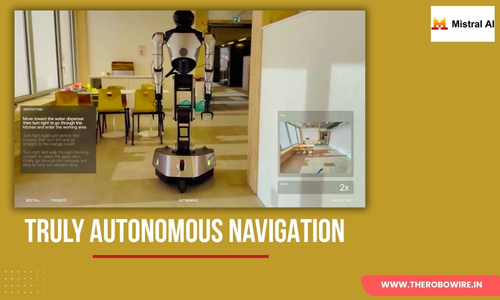
Robostral Navigate is an 8B embodied navigation model that follows natural language instructions and guides robots through offices, homes, commercial sites, and outdoor environments.
Instead of relying on LiDAR or depth sensors, it uses a standard RGB camera and still delivers a 76.6 percent success rate on the R2R-CE “validation unseen” benchmark and 79.4 percent on “validation seen,” outperforming many multi-sensor systems. That combination of performance and simplicity makes it especially compelling for robotics platforms that need to keep hardware costs low and sensor stacks lean.
Under the hood, the model takes a sequence of camera images plus a text instruction and decides where the robot should move next using a pointing-based navigation strategy.
It predicts target coordinates in the current camera frame along with the desired orientation at the destination, which naturally adapts to different camera characteristics and scales.
When the target slips out of view, Robostral Navigate switches to local displacement commands, move forward a certain distance, turn by a specific angle, so it can handle long, winding routes in cluttered spaces.
Importantly, Robostral Navigate is built entirely in-house. Mistral AI didn’t just fine-tune an existing open-source vision-language model; instead, it started from its own grounding-focused VLM, which already understands pointing, counting, and object localization.
Navigation becomes the next logical step on top of those skills. To train the model, the team built a simulation-based data pipeline that generated roughly 400,000 navigation trajectories across 6,000 scenes, giving the system exposure to a wide variety of environments and layouts.
Training efficiency is a big part of the story. One key innovation is a supervised training scheme based on prefix-caching and tree-based attention masking.
This setup compresses an entire navigation episode into a single sequence and trains across all time steps in one forward pass, cutting training tokens by a factor of 22 while keeping the learning signal intact.
On top of that, Mistral uses online reinforcement learning with the CISPO algorithm, allowing the model to learn from trial and error, recover from failures, and improve its exploratory behavior. This approach boosts success rates by 3.2 percentage points, with clear room for further improvement.
The impact on robotics is significant. Robostral Navigate works across wheeled, legged, and flying robots and generalizes to different robot sizes and camera configurations, hinting at a more unified approach to embodied AI.
For manufacturers, logistics operators, and service robotics companies, achieving high-quality navigation from a single camera can lower hardware complexity and deployment costs while unlocking more advanced autonomous behaviors on the factory floor or in public spaces. Mistral positions navigation as a foundational building block for general-purpose robots and sees Robostral Navigate as an early step toward fully embodied AI  agents.
This release also fits into a broader robotics roadmap. Mistral AI is actively growing its AI Science Robotics team, looking for researchers and engineers to push navigation performance further and extend these capabilities to tougher environments and more demanding tasks.
With simulation, compact models, and reinforcement learning at scale, future milestones are likely to focus on richer embodied skills built on top of Robostral Navigate’s navigation core.
To Know More: CLICK HERE