


Hanyang University ERICA Researchers Develop Electronic Skin That Brings Human-Like Touch to Robots and Prosthetics.

Researchers at Hanyang University ERICA have demonstrated a new way to give robots and prosthetic devices a far more natural sense of touch.
Led by Associate Professor Jaekyun Kim from the Department of Photonics and Nanoelectronics, the team has developed a vertically integrated, dual-gated tribotronic transistor that can reliably sense both contact and proximity while remaining compact enough for high-density, large-area integration. Their findings were first made available online on April 9, 2026, and later published in Volume 153 of Nano Energy.
In recent years, the rise of miniaturized, portable, and flexible electronics has driven strong interest in self-powered sensing technologies, especially for wearable and soft devices. Triboelectric nanogenerators (TENGs), which convert mechanical stimuli such as touch or pressure into electrical signals via charge redistribution, have emerged as a promising route to build highly sensitive tactile sensors for electronic skin and intelligent robotics.
At the same time, most conventional tribotronic devices which couple triboelectric effects with transistor operation, still struggle with fixed, non-tunable sensitivity and are difficult to scale into large-area architectures, limiting their use in practical systems.
Kim’s team set out to tackle these limitations with a fresh device architecture. Their vertically integrated dual-gated tribotronic transistor stacks a polydimethylsiloxane (PDMS) triboelectric sensing layer on top of a dedicated gate insulator, which is then placed over an indium-tin-zinc-oxide (ITZO) thin-film transistor (TFT).
In this configuration, the bottom gate establishes the baseline current through the ITZO transistor, while the PDMS layer serves as a triboelectric top gate that modulates the current in response to touch or nearby objects.
According to Dr. Kim, “Our vertical dual-gate architecture not only offers gate-tunable amplification of the triboelectronic responses, but also minimizes pixel footprint, enabling high-density, large-area integration.”
The sensing process begins with a charging step, a stainless-steel plate is brought into contact with the PDMS surface, generating triboelectric charges at the interface. When the plate moves away, those accumulated charges create a triboelectric potential that effectively acts as a top-gate voltage, suppressing current flow through the ITZO transistor.
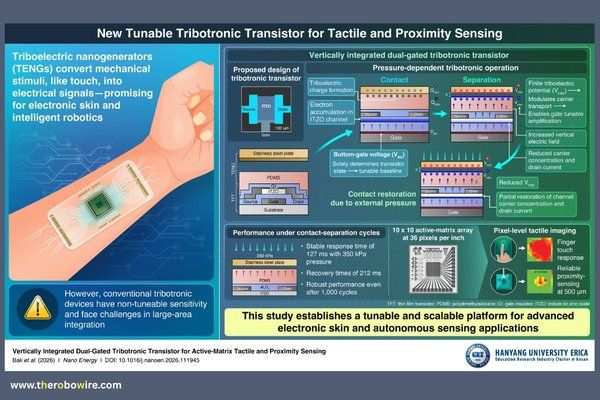 As the charged plate or another object approaches the PDMS layer again, the triboelectric potential gradually decreases, allowing the transistor current to recover depending on how close the object is. This variation in current constitutes the tribotronic response, enabling both contact and proximity detection.
At the same time, the bottom-gate voltage remains a powerful tuning knob, by adjusting it, the researchers can set the baseline current and electrically control the device’s sensitivity, which was found to increase with higher bottom-gate voltages.
The team also observed that higher contact pressure enhances the effective contact area between the PDMS layer and the touching object, generating more triboelectric charge and producing a stronger electrical response.
In repeated tests, the device showed stable dynamics, with response and recovery times of 127 milliseconds and 212 milliseconds, respectively, during each contact–separation cycle. Performance remained robust even after 1,000 operating cycles, suggesting that the architecture is mechanically and electrically reliable enough for long-term use in real-world systems.
To showcase the technology’s potential for active tactile sensing, the researchers fabricated a 10 × 10 transistor array using their  dual-gated design. After initially charging the PDMS sensing layer with a stainless-steel plate, they demonstrated clear, pixel?level signals in response to finger touches.
The array also delivered reliable proximity sensing, detecting a stainless-steel probe at distances of up to 500 micrometers. These capabilities, tunable sensitivity, compact pixel footprint, and scalable array integration, position the platform as a compelling building block for future electronic skin.
“Our research could contribute to the development of electronic skin systems that allow robots, prosthetic devices, and wearable electronics to perceive touch, pressure, and proximity more precisely,” says Dr. Kim. “This will lead to safer and more reliable human–machine interaction, with applications in healthcare robots, health monitoring and autonomous systems.” By combining dual?gate control with triboelectric sensing in a vertical stack, the team has delivered a scalable, programmable, and mechanically robust tribotronic sensor architecture that brings human?like touch perception a step closer for next?generation human–machine interfaces.
Reference
Title of original paper: Vertically integrated dual-gated tribotronic transistor for active-matrix tactile and proximity sensing
Journal: Nano Energy