


Researchers at Shanghai Jiao Tong University have developed a miniature optical sensor that could give robots and medical instruments a new level of tactile perception.
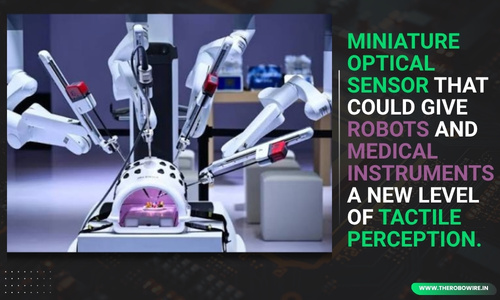
Measuring just 1.7 mm, the grain sized device can detect force and twisting in six directions using light rather than conventional electronic sensing elements.
The technology could be particularly useful in robotic manipulation and minimally invasive medical procedures, where space is limited and conventional force sensors are often too large.
The development was detailed in the journal Optica and highlighted by Optica Publishing Group in a May 2026 research release.
A Smaller Approach to Tactile Sensing
Robotic systems increasingly rely on cameras and other sensors to understand their surroundings, but visual information alone cannot reveal how strongly a tool is pressing against an object or whether it is beginning to twist or slip.
That limitation becomes more significant in compact robotic instruments. Conventional six degree of freedom force and torque sensors can involve multiple sensing elements, complex wiring and relatively bulky structures, making further miniaturization difficult.
The Shanghai Jiao Tong University team took a different approach by using an optical signal to capture mechanical interaction.
At the center of the sensor is an optical fiber fitted with a soft elastomer tip. When the tip comes into contact with an object, it undergoes a small deformation. That deformation changes the distribution of light inside the optical structure.
The resulting light pattern travels through a coherent fiber bundle to a camera. Algorithms then interpret the pattern to estimate forces and torques across all six degrees of freedom, covering three directions of force and three directions of rotational movement.
One Optical Channel, Six Degrees of Freedom
The researchers’ work, titled “Deformation encoded light field transduction enables 6 DoF optical force sensing in a 1.7 mm footprint,” describes an all optical sensing architecture designed to reduce the complexity normally associated with multidirectional force measurement.
Rather than using separate sensing components for each force or torque component, the system encodes mechanical deformation into a spatial light pattern. A machine learning based calibration process then maps those optical responses to mechanical loads.
The study reports highly repeatable measurements with low hysteresis and real time force and torque feedback. The research team also developed a generative self calibration framework to improve the system’s ability to learn the relationship between optical responses and applied loads while reducing the amount of experimental calibration data required.
For robotics, this approach could offer a route toward smaller tactile sensing systems without adding extensive wiring or a large number of sensing elements.
Testing the Sensor on Hidden Structures
The researchers also explored how the sensor could be used to detect structures that cannot be identified through direct visual inspection.
In proof of concept experiments, the team used tissue like models containing stiff spherical structures designed to represent tumors. By interacting mechanically with the material, the sensor was able to identify and locate the embedded structures.
This capability could have implications for minimally invasive medical robotics. Surgical tools often need to operate through narrow access points, where there is limited room for conventional sensing hardware.
A miniature force and torque sensor could allow robotic instruments to detect contact conditions that cameras cannot capture. That could help systems recognize unexpected contact, distinguish differences in tissue stiffness and adjust their movements in real time.
The researchers see potential applications in areas such as minimally invasive intervention, medical instruments and robotic systems operating in constrained environments.
Why Tactile Perception Matters in Robotics
The move toward tactile robotics reflects a broader shift in how machines interact with the physical world.
Vision gives robots information about shape, position and movement, but touch provides another layer of information. Tactile sensors can help machines estimate properties such as force, texture, stiffness and contact conditions. These signals are particularly important when robots need to manipulate delicate, irregular or partially hidden objects.
Recent research has also demonstrated multimodal tactile systems capable of identifying material characteristics, temperature, vibration and contact forces, highlighting the growing role of touch in advanced robotic perception.
For industrial robots, tactile sensing could improve precision during assembly, inspection and manipulation. In healthcare, it could support robotic tools that need to operate safely around delicate tissue.
In future humanoid and service robots, tactile feedback could also help machines adjust their grip instead of relying entirely on visual estimates.
From Laboratory Demonstration to Practical Deployment
The 1.7 mm sensor is still a research prototype, and several challenges remain before the technology can be widely deployed.
The research team has identified manufacturing consistency and calibration as areas requiring further development. Practical deployment will also require compact packaging, robust operation and testing under real operating conditions rather than controlled laboratory setups.
Those challenges are important because a sensor designed for surgical or industrial robotics must maintain its performance despite temperature changes, mechanical bending, repeated contact and variations between individual devices.
The research paper reports that the sensing approach remains robust under temperature and bending variations, but translating those results into reliable mass manufactured products will require additional validation.
A New Direction for Miniature Robotic Sensors
The development from Shanghai Jiao Tong University points to a growing effort to make tactile sensing smaller, simpler and more capable.
At only 1.7 mm, the sensor demonstrates that multidirectional force and torque measurement does not necessarily require a large electronic sensing package. By using deformation encoded optical signals and computational calibration, the researchers have created a compact platform that could fit into applications where conventional sensors struggle to operate.
For the robotics industry, the significance extends beyond the sensor itself. Machines that can combine vision with precise physical feedback will be better equipped to manipulate objects, operate in confined spaces and respond to unexpected contact.
As robotics moves toward more dexterous and autonomous systems, the ability to feel may become just as important as the ability to see.
References
- Interesting Engineering, “China builds rice-sized sensor that lets surgical robots feel touch in real time.”
- Optica Publishing Group, “Tiny sensor harnesses light to feel touch,” May 7, 2026.
- Zhang, W. et al., “Deformation-encoded light-field transduction enables 6-DoF optical force sensing in a 1.7 mm footprint,” Optica, Vol. 13, No. 5, 2026. DOI: 10.1364/OPTICA.582941.
- Shanghai Jiao Tong University, School of Biomedical Engineering, May 9, 2026.