

Kerala-based deep-tech company Genrobotics has entered into a Memorandum of Understanding with the Territorial Army to explore the use of robotics across defence, disaster response and other high-risk operational environments.
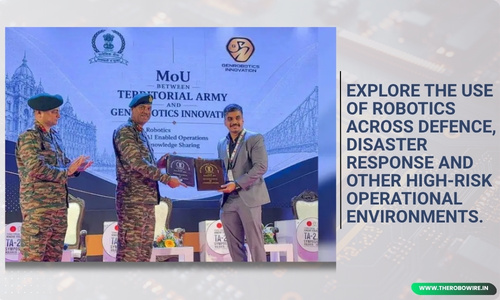
The agreement was signed on August 29 at the KYTA & TA 2.0 Symposium in Kolkata. It brings together Genrobotics’ indigenous robotics capabilities with the Territorial’s operational requirements, with a focus on developing and evaluating technologies that can support personnel in hazardous situations.
Under the partnership, the two sides will explore robotic applications in disaster response, Humanitarian Assistance and Disaster Relief, confined-space operations, critical infrastructure inspection, engineering support and hazardous environment missions. The scope also includes AI-enabled inspection and remote sensing.
Moving robotics from development to field trials
A key element of the collaboration will be the transition from technology development and demonstrations to practical operational evaluation.
The partnership includes technology demonstrations, user trials and specialist training. These activities are expected to give the Territorial Army an opportunity to assess robotic systems against real-world requirements while building the skills needed to deploy and operate them effectively.
The MoU was signed on behalf of the Territorial Army by Maj Gen SS Patil, AVSM, VSM, Additional Director General of the Territorial Army. Vimal Govind M.K., CEO and Co-founder of Genrobotics, signed the agreement for the company.
The partnership was announced during the TA 2.0 Symposium, where discussions also focused on how India’s civilian technology ecosystem can contribute to strengthening military capabilities.
Genrobotics puts new robotic platforms on display
Alongside the partnership, Genrobotics showcased several of its robotic platforms at the symposium, highlighting the company’s expanding focus beyond its traditional sanitation robotics business.
One of the key exhibits was G-Bot, a bipedal robot prototype and the company’s first public showcase of a pure humanoid robot. The company also demonstrated Genbot, a robotic rover, along with G-KAI, a rehabilitation system developed for upper-body recovery.
The company’s growing portfolio reflects its move into applications across defence, healthcare, infrastructure and other environments where robotics can reduce the need for direct human intervention.
The company is widely recognised for its Bandicoot robotic systems, which were developed to address the risks associated with manual manhole and sewer cleaning. That experience in confined and hazardous environments is now providing a foundation for the company to explore a broader range of mission-critical applications.
Strengthening its presence in the defence and space sectors
Genrobotics recently inaugurated a dedicated production facility in Thumba, Kerala, aimed at research, development and manufacturing activities related to these areas.
It has also added experienced professionals, including retired engineers from organisations such as ISRO and the Indian Army, to support its technology development efforts.
The move reflects a wider push by Indian deep-tech companies to develop homegrown technologies for applications where reliability, remote operation and reduced human exposure are critical.
The real test will be operational deployment
While prototypes and demonstrations can establish the technological potential of robotic systems, their ability to perform consistently in demanding field conditions will ultimately determine their value to defence and disaster response teams.
Robots deployed in these environments may need to navigate unpredictable terrain, inspect infrastructure, collect information remotely or operate in areas that are unsafe for personnel. Their effectiveness will therefore depend not only on mobility and sensing capabilities but also on reliability and ease of operation.