

Hyundai Motor just turned the FIFA World Cup 2026™ into a live showcase for advanced robotics.
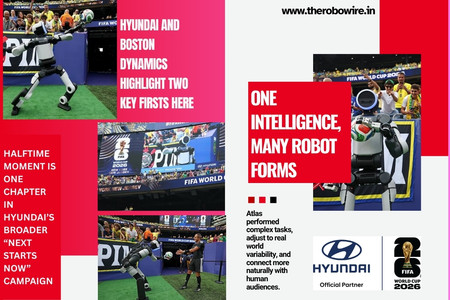
During the Round of 16 match at New York/New Jersey Stadium, the company brought Atlas®, the humanoid robot developed by Boston Dynamics, onto the pitch as part of a halftime activation. As the Official Robotics Partner of the tournament, Hyundai delivered what it calls the first robotics powered halftime show on football’s biggest stage, putting cutting edge robotics in front of a global audience in real time.
The moment is a clear signal of Hyundai Motor Group’s growing ambitions in robotics and its focus on human centered innovation using technology in ways that feel engaging, relatable and deeply connected to everyday experiences.
Why this matters for robotics and sport
This activation did more than entertain the crowd. It showed that an advanced humanoid robot can operate inside one of the most demanding live environments in the world – a FIFA World Cup match. That’s a very different setting from a lab demo or a staged indoor performance.
Hyundai and Boston Dynamics highlight two key firsts here. It was the first public demonstration of the real world movement capabilities of the production version of Atlas, which made its debut earlier at CES 2026. It was also the first time a humanoid robot has been integrated into a live FIFA World Cup match environment.
For Hyundai, this fits squarely within its “Progress for Humanity” vision. The company wants to show that robotics is not an abstract future concept, but something that can create meaningful, shared moments for fans right now.
Sungwon Jee, Executive Vice President and Global Chief Marketing Officer at Hyundai Motor Company, summed it up by saying that under the “Next Starts Now” campaign, Atlas’s performance is meant to prove that the future is already here.
Hyundai’s goal is to develop human centered innovation that blends into daily life and to expand its view of future mobility through robotics, positioning robots as trusted partners in humanity’s progress.
What Atlas did during halftime
At halftime, Atlas walked out from the player tunnel and immediately became the focus of the stadium.
The robot performed a series of iconic goal celebrations inspired by star players like Harry Kane, Erling Haaland, Matheus Cunha and Son Heung min. The routine was designed to amplify the stadium atmosphere while also showing off Atlas’s agility, balance and expressive movement.
After the celebrations, Atlas took on a more ceremonial role, delivering the match ball to the referee with careful, precise control to start the second half. All of this played out live, with Atlas executing coordinated motions and interacting smoothly in a crowded, high energy setting. For a humanoid robot, doing this outside a controlled environment is a significant step.
How Atlas learned those football moves
Behind the scenes, the halftime show was a technical exercise in advanced robotics capabilities. Atlas relied on a mix of:
- Retargeting technology, which lets the robot take human movements — like player celebrations and gestures — and adapt them to its own structure and range of motion.
- Reinforcement learning, where thousands of simulated trials are used to train and refine movements before the robot ever steps into a live setting.
- Whole body control, which coordinates all joints and limbs so Atlas can move fluidly, stay balanced and react dynamically to changing conditions.
Together, these systems allow Atlas to perform complex tasks, adjust to real world variability, and connect more naturally with human audiences.
Alberto Rodriguez, Director of Robotics Behavior at Boston Dynamics, noted that the team has long drawn inspiration from human athletic performances — gymnastics, dance, parkour and now football — to push the boundaries of what robots can do while keeping the results relatable. He pointed out that the way Atlas was trained for fun movements at the match is very similar to how the robot is prepared for real industrial applications, making this event a bridge between entertainment and practical use cases.
Part of Hyundai’s “Next Starts Now” story
This halftime moment is one chapter in Hyundai’s broader “Next Starts Now” campaign, which uses football as a way to connect communities and inspire the next generation of players, fans and technologists. Bringing Atlas into a live match environment turns earlier conceptual demos into a tangible, shared experience on one of the world’s biggest stages.
It also extends the narrative built in Hyundai’s “School of Football” content series, where Atlas learned football inspired moves such as the “Ghost Rabona” using the same underlying robotics technologies that were showcased at the World Cup. Hyundai plans to share more behind the scenes material and storytelling from the activation across its own channels in the weeks following the event.
On top of that, Hyundai Motor and BBC StoryWorks Commercial Productions will release “The Training Ground,” a documentary style film that walks through the technical preparation behind Atlas’s World Cup appearance. The feature will be available as a 3.5 minute full version and a 30 second cutdown, scheduled for release on July 7 across Hyundai’s social platforms.
What’s next for robotics at Hyundai Motor Group
For Hyundai Motor Group, this World Cup activation is its most visible robotics demonstration yet, and it clearly signals that the company intends to keep pushing the envelope.
As Hyundai continues to invest in robotics, autonomous systems and human centered innovation, it is looking for ways these technologies can create meaningful experiences and help shape a more connected future.
By weaving together sport, advanced technology and strong storytelling at FIFA World Cup 2026™, Hyundai is reinforcing its “Progress for Humanity” vision. The Atlas halftime show is a reminder that innovation doesn’t have to live only in labs and trade shows — it can be part of the moments that millions of people enjoy together, in real time.