


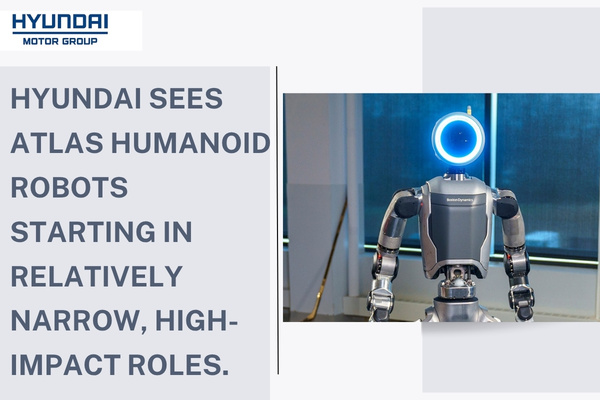
Hyundai sees Atlas Humanoid Robots starting in relatively narrow, high-impact roles. In the early phase, they’ll handle parts sequencing and other repetitive tasks, taking over the kinds of motions that are monotonous or physically taxing for human workers.
Hyundai Motor Group has laid out one of the boldest humanoid-robot plans in the auto industry, a commitment to deploy more than 25,000 Atlas robots across its US manufacturing network.
The move signals that Hyundai Motor Group isn’t just experimenting with automation it’s betting heavily on “physical AI” as a core lever for reshaping how cars are built.
A 25,000-robot ramp-up
During an investor session hosted by JPMorgan, Hyundai outlined how Atlas humanoid robots developed by Boston Dynamics, in which the group holds a majority stake will be rolled out across Hyundai Motor and Kia plants in the United States.
The automaker is targeting an annual production capacity of up to 30,000 Atlas units by 2028, a clear sign that humanoid robotics is being treated as a long-term, scalable capability rather than a short-term pilot.
The rollout is part of a broader push to integrate humanoid robots into core production workflows, from parts sequencing and logistics to later-stage assembly and heavy-duty operations.
Hyundai hasn’t yet mapped out a plant-by-plant schedule in detail, but earlier statements point to Atlas Humanoid Robots first appearing at Hyundai Motor Group Metaplant America in Georgia in 2028, with a second wave at Kia’s Georgia plant in 2029.
Hardware that mirrors human motion
Atlas is far more than a next-gen robot arm. Hyundai describes it as a fully autonomous humanoid platform capable of navigating industrial environments, with a payload capacity of up to 50 kg (about 110 lb) and resilience across temperatures from roughly -20°C to 40°C.
The robot’s human-scale hands are fitted with tactile sensors, allowing it to pick up, position, and manipulate parts much the way a human operator would.
To support this scale of deployment, Hyundai is also planning to manufacture over 300,000 actuator units per year in the US.
Actuators form the “joints and muscles” of the robot, so localizing this layer of the stack not only cuts logistics risk but also reinforces Hyundai’s strategy of embedding advanced manufacturing more deeply into North America.
Where Atlas will work on the shop floor
Hyundai sees Atlas Humanoid Robots starting in relatively narrow, high-impact roles. In the early phase, they’ll handle parts sequencing and other repetitive tasks, taking over the kinds of motions that are monotonous or physically taxing for human workers.
By 2030, the automaker expects Atlas units to move into more complex assembly steps, heavy lifting, and operations that carry greater safety risk.
The long-term vision is less about replacing people and more about redefining teamwork. Hyundai frames Atlas as a partner that shoulders the physical load while human workers shift toward supervision, maintenance, training, and higher-value engineering and quality roles.
The group is also partnering with major AI players such as Nvidia and Google to fine?tune perception, motion planning, and safety algorithms tailored to industrial humanoid use cases.
 What this means for the auto and industrial sector
Hyundai’s 25,000-unit Atlas Humanoid Robots target is a strong indicator that humanoid robots are moving beyond lab demos and press-tour stunts into real-world, high-volume deployment.