


For decades, robots were associated with automobile factories and warehouse automation. Today, that picture is changing rapidly. Governments around the world are beginning to deploy robots not as futuristic spectacles, but as practical tools for delivering public services. From inspecting bridges and cleaning sewers to responding to disasters and assisting surgeons, robotics is becoming an increasingly important component of modern governance.

This transformation mirrors earlier waves of technological change. Governments were among the earliest adopters of computers to process census data, taxation, and social security. Artificial intelligence is now helping automate knowledge work. Robotics extends this evolution into the physical world, allowing governments to automate tasks that require movement, sensing, and interaction with the environment.
Unlike software, robots can inspect infrastructure, collect environmental data, transport supplies, and operate in hazardous locations. They represent the physical embodiment of digital government.
Infrastructure Inspection
One of the most mature applications of robotics lies in infrastructure management. Globally, governments are responsible for maintaining thousands of kilometres of roads, railway tracks, bridges, tunnels, pipelines, dams, and power transmission networks. Traditional inspections are expensive, time-consuming, and often expose workers to unnecessary risks.
Autonomous drones now inspect bridges, power lines, and railway corridors using high-resolution cameras and thermal sensors. Underwater robots survey dams, reservoirs, and ports without requiring divers. Crawling robots examine pipelines and sewer networks where human entry is dangerous or impossible.
Combined with artificial intelligence, these robots can detect cracks, corrosion, water leakage, and structural weaknesses long before they become public safety hazards.
Instead of reactive maintenance, governments can increasingly adopt predictive maintenance, improving both safety and fiscal efficiency.
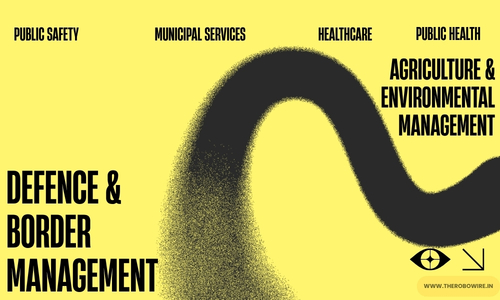
Public Safety and Emergency Response
Robotics has become an essential tool during emergencies. Search-and-rescue robots can enter collapsed buildings following earthquakes.
Bomb disposal robots reduce the risks faced by police personnel. Firefighting robots can operate in environments with extreme temperatures and toxic gases where human firefighters cannot safely enter.
During floods, drones assist emergency responders by mapping inundated areas, locating stranded citizens, and delivering essential medicines to isolated communities.
Rather than replacing emergency personnel, robotics expands their operational reach while reducing exposure to danger.
Municipal Services
Cities are also experimenting with robotic public services. Autonomous street-cleaning machines, robotic waste collection systems, sewer inspection robots, and park maintenance robots are increasingly being deployed in urban environments.
These technologies are particularly valuable for occupations involving repetitive work, hazardous conditions, or chronic labour shortages.
As cities grow larger and urban infrastructure becomes more complex, municipal robotics offers a practical way to improve service delivery while controlling operational costs.
Healthcare and Public Health
Public healthcare systems have embraced robotics in several domains.Robotic-assisted surgery has improved precision for complex procedures in public hospitals. Automated pharmacy systems reduce dispensing errors.
Mobile robots transport medicines, laboratory samples, and medical equipment across hospital campuses.
During infectious disease outbreaks, robots have also been used for hospital disinfection, contactless delivery, and telepresence, reducing the exposure of healthcare workers.
In ageing societies, assistive robots may also support elderly care, rehabilitation, and home-based healthcare services.
Agriculture and Environmental Management
Many governments support agriculture through extension services, environmental monitoring, and resource management.
Drones equipped with multispectral cameras help monitor crop health, estimate yields, and detect pest infestations. Autonomous environmental robots collect water-quality data, monitor forests, and observe wildlife populations.
Such technologies improve the government’s ability to manage natural resources while supporting evidence-based policymaking.
Defence and Border Management
Although military robotics often attracts media attention, governments increasingly employ robotic systems for non-combat administrative purposes. Autonomous surveillance systems monitor borders, ports, and critical infrastructure.
Unmanned aerial vehicles conduct reconnaissance during disaster relief, maritime patrol, and environmental monitoring. Ground robots assist with logistics, route clearance, and hazardous material handling.
These systems improve operational efficiency while reducing risks to personnel.
The Indian Opportunity
India’s expanding Digital Public Infrastructure provides a unique platform for integrating robotics into governance.
Smart cities, railway modernization, highway management, sanitation, healthcare, agriculture, and disaster management all present opportunities for robotic deployment.
For a country managing infrastructure at continental scale, robotics can improve inspection quality, accelerate maintenance, enhance worker safety, and support evidence-based decision-making.
Rather than replacing public servants, robots are likely to augment administrative capacity by handling physically demanding, repetitive, or hazardous tasks while allowing officials to focus on planning, supervision, and citizen engagement.
Challenges Ahead
Despite its promise, government adoption of robotics raises important policy questions.Public agencies must address procurement standards, cybersecurity, data governance, interoperability, workforce training, maintenance costs, and ethical considerations. Regulations governing autonomous systems remain uneven across jurisdictions.
There are also broader questions about accountability. When an autonomous inspection system misses a structural defect or a robotic platform makes an operational error, responsibility ultimately rests with public institutions.
Effective governance therefore requires robust oversight, transparent decision-making, and clear human accountability.
Conclusion
Robotics should not be viewed simply as another technological innovation. It represents the next stage in the long evolution of public administration.
If computers automated government paperwork and artificial intelligence is beginning to automate administrative reasoning, robotics enables governments to automate physical operations in the real world.
The governments that successfully integrate robotics into public service delivery will not necessarily have the most advanced machines.
They will be the ones that redesign institutions, workflows, and public services around these new capabilities. In the coming decade, robotics is likely to become as fundamental to government operations as computers became in the late twentieth century; not a novelty, but an essential instrument of modern state capacity.
About The Author: Soham Bose, is a policy consultant with over six years of experience in policy design and communication. He has worked with both the Central Govt and a number of state governments on varied issues like Digital Public Infrastructure, Public Finance, Trade Promotion and Heritage.