


For humans, moving through the world is effortless. For tiny robots, it’s anything but. Their small size limits how much power and computing they can carry, making it difficult to navigate cluttered, unpredictable environments. A new MIT chip developed by their researchers could help change that, giving micro-robots the ability to move more intelligently and independently.
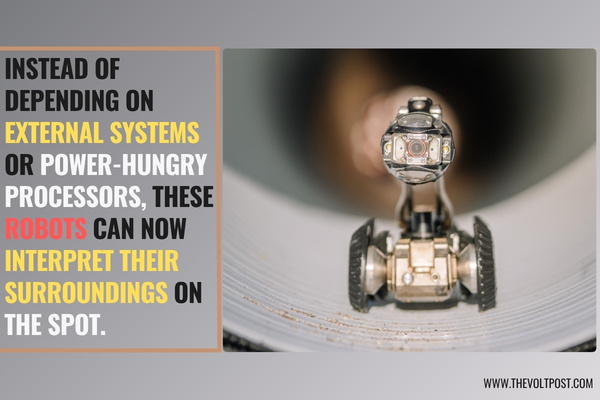
The chip is designed to process visual data in real time, right on the robot itself. Instead of depending on external systems or power-hungry processors, these robots can now interpret their surroundings on the spot.
That means quicker decisions, lower energy use, and greater autonomy especially important for machines operating in confined or hard-to-reach areas.
What sets this approach apart is how efficiently it handles complex visual information. Traditionally, small robots have had to send data elsewhere for processing, which adds delay and drains power. This new design keeps everything onboard, allowing robots to detect obstacles and adjust their path almost instantly.
The potential applications are broad. In healthcare, micro-robotics could move through the human body with improved precision, supporting less invasive treatments. In industrial environments, they could inspect equipment, pipelines, or hazardous zones where larger machines simply can’t go.
The MIT chip also improves how these robots map and understand their surroundings. By strengthening both localization and perception, it helps them stay oriented even in dynamic settings where conditions can shift quickly. This is a key step toward making small robots truly independent in real-world scenarios.
Energy efficiency is another major advantage. Since these robots operate on tight power budgets, reducing energy consumption is critical. The chip is built to perform demanding computations while using minimal power, helping extend operational time and making continuous deployment more realistic.
As the robotics industry pushes toward smaller and more capable systems, advances like this are becoming essential. By combining compact hardware with intelligent processing, MIT’s work brings micro-robots closer to navigating complex environments with confidence.
 It also reflects a larger shift in both robotics and chip design moving intelligence closer to the edge. Rather than relying on cloud-based processing, more systems are embedding AI capabilities directly into hardware. For micro-robotics, that shift could open the door to entirely new use cases that were previously out of reach.
To Know More: CLICK HERE