

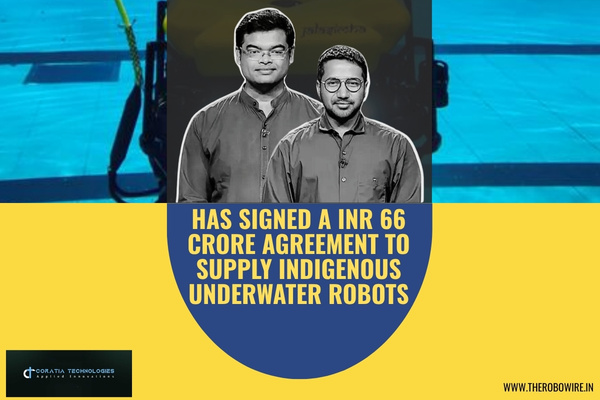
An underwater robotics startup from Odisha has become one of the most compelling deeptech stories in India, and the Indian Navy has already moved beyond pilot projects to a full contract. Coratia Technologies, incubated at NIT Rourkela, has signed a INR 66 crore agreement to supply indigenous underwater robots, a deal that marks a significant step in the Navy’s effort to replace imported platforms with home-grown systems.
 From classroom idea to defence contract
Coratia’s journey began as an engineering project at the National Institute of Technology in Rourkela, where founders Debendra Pradhan and Biswajit Swain started exploring safer ways to inspect underwater structures without putting divers into deep, cold or low-visibility environments.
What started in the lab has since evolved into a company focused on underwater robots and marine inspection, with support from incubators at NIT Rourkela and other hubs in Odisha and Gujarat and backing from programmes such as Startup Odisha, NIDHI and the Ministry of Defence’s innovation schemes.
From the beginning the goal was clear and ambitious. Coratia set out to build Indian underwater robots that could handle inspection and surveillance missions more safely and more cost?effectively than traditional diver-based methods, using a combination of custom hardware and AI-driven analytics instead of imported off-the-shelf systems.
That focus has now taken the startup from infrastructure pilots to one of the most closely watched defence contracts in the country.
What the INR 66 crore Navy deal really covers
The Indian Navy contract, valued at INR 66 crore, covers the supply and support of Underwater Remotely Operated Vehicles, or UWROVs, designed and manufactured in Odisha. Coratia describes it as the first large-scale induction of India-built UWROVs into active naval operations, pushing underwater robotics firmly into the same Atmanirbhar Bharat conversation that has shaped recent decisions on fighter aircraft, artillery and electronic warfare systems.
The deal sits under the Ministry of Defence’s iDEX innovation framework and includes platforms such as Jalasimha, Coratia’s flagship work-class underwater robot.
Jalasimha has completed deep-water trials and achieved Technology Readiness Level 9, the highest deployment-readiness rating used in mission frameworks like NASA’s.
In practice this means the Navy is planning to use these robots for real missions, from routine hull inspections to more demanding surveillance and search operations, rather than treating them as lab-scale prototypes.
Inside Coratia’s underwater robots
Coratia builds two main categories of machines. One is tethered Remotely Operated Vehicles controlled from the surface by an operator. The other is Autonomous Underwater Vehicles that can navigate and execute missions using onboard sensors, navigation and control software.
Jalasimha is the best known UWROV in the fleet. It has been tested at depths beyond 450 metres in the Bay of Bengal, with endurance above twelve hours and a top speed of roughly three knots.
The robot carries a sensor suite closer to a professional survey vessel than a student build, including multibeam sonar, stereo vision, leak-detection probes, 360-degree imaging and an integrated robotic arm capable of manipulating underwater objects during maintenance, inspection and salvage work.
All of that sensor data is fused and processed with AI and machine learning, allowing the system to flag anomalies, shorten mission timelines and generate more reliable maps and inspection reports than manual methods.
Alongside Jalasimha, Coratia has developed Jaladuta, a work-class vehicle aimed at submerged infrastructure such as dams and bridge foundations, and Navya, an autonomous surface vessel that supports sonar-based mapping and data collection from the surface.
Together these platforms span close-range visual inspection and wider bathymetric surveys for ports, pipelines and subsea cables.
Beyond defence, robots for dams, pipelines and ports
The Navy deal may be the headline, but Coratia’s robots were already at work in civilian and industrial projects before the contract was signed. The company lists customers such as Indian Railways, SAIL, Indian Oil and Tata Steel, using UWROVs to inspect dam walls, bridge foundations, underwater pipelines and harbour structures.
The same systems are used for ocean-floor mapping, monitoring marine ecosystems, checking offshore energy installations and supporting emergency missions such as post-flood structural assessments and water-quality measurement.
This dual?use profile strengthens the business case. Defence deployments justify the investment in reliability, certification and ruggedisation, while commercial jobs in ports and industrial sites keep the robots busy between naval tasks.
In effect, Coratia is building a shared underwater data and inspection layer that serves defence, industry and public agencies on the same technical base.
Why underwater robotics matters for India
For years the Indian Navy has relied on imported underwater platforms for inspection and surveillance, exposing day-to-day operations to higher costs, foreign dependencies and export-control risks. Shifting to indigenous UWROVs changes that equation.
It reduces procurement and long-term support costs, lowers exposure to overseas regulations and gives the service greater control over hardware, software and data.
Underwater robots also align closely with India’s wider strategic priorities. They bolster security around ports and critical subsea infrastructure such as communication cables and offshore energy assets, all of which are central to the country’s ambitions in the blue economy.
 They reduce risk for human divers operating in hazardous conditions and make underwater surveys faster, more repeatable and more data-rich, which matters as extreme weather and coastal change reshape rivers and coastlines.
A niche underwater robotics project from an Odisha campus has grown into a Navy supplier with a sizeable contract while continuing to serve infrastructure and industrial clients.
It shows how targeted hardware, AI and marine engineering can move from the lab to the fleet and help the country see and secure the world beneath the surface.
To Know More: CLICK HERE