


NASA has kicked off a bold, first?of?its?kind robotic rescue mission to save its Swift space telescope from falling back to Earth, in a move that could redefine how aging satellites are supported in orbit. The operation is not just about one observatory, it is a live test of what satellite servicing might look like in the coming decade.
A rescue mission for Swift
Swift, formally the Neil Gehrels Swift Observatory, has spent more than twenty years tracking gamma?ray bursts and other powerful cosmic events.
Over time, its orbit has been pulled lower than expected, largely due to heightened solar activity, leaving the telescope at serious risk of re?entering the atmosphere and burning up later this year.
To avoid losing a still?valuable scientific asset, NASA signed off on a 30?million?dollar salvage mission built around a dedicated robotic spacecraft called Link, opting to see whether modern satellite?servicing technology can extend Swift’s life instead of investing in a brand?new replacement.
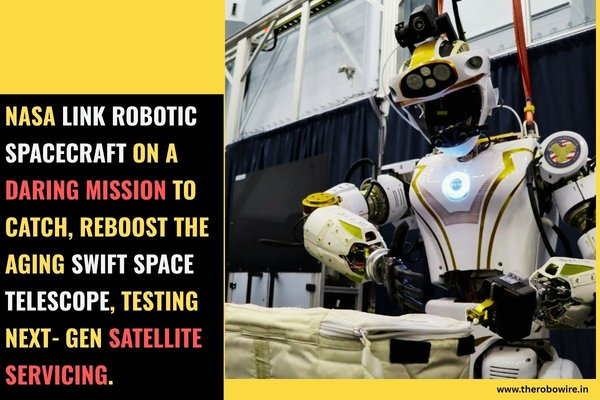
Link, the three?armed space robot
Link was developed by Arizona?based startup Katalyst Space Technologies as part of NASA’s broader effort to tap commercial partners for in?orbit servicing capabilities.
Roughly the size of a large household refrigerator, Link is equipped with three robotic arms, multiple cameras, guidance sensors and small thrusters so it can find Swift, grab onto it and carefully maneuver the observatory in space.
The robot was launched on a Pegasus rocket that was air?dropped from a modified aircraft over the Pacific, sending Link into orbit on a course to rendezvous with Swift.
In the weeks after launch, the spacecraft will power up, check that all systems and instruments survived the ride to orbit, and then begin a carefully planned approach to the telescope.
How the orbital rescue will work
Mission teams expect robotic mission to reach the vicinity of Swift in about a month. After that, it will spend several weeks circling and inspecting the telescope to figure out the safest way to capture it.
Because Swift Space Telescope was never designed with docking fixtures, Link cannot rely on standardized ports, it has to use its robotic arms to latch onto structural elements on the spacecraft itself.
Once it has a firm grip, Link will slowly fire its thrusters to raise Swift’s orbit from roughly 360 kilometers up to around 600 kilometers, close to where the observatory originally operated. This reboost is expected to take two to three months, with engineers prioritizing gentle, precise maneuvers that avoid stressing the aging hardware.
A test case for satellite servicing
NASA and its partners see the Swift mission as a high?risk, high?reward demonstration of what commercial satellite servicing in low Earth orbit can achieve.
If the operation goes well, Swift could gain up to another decade of observing time, continuing to catch transient, hard?to?predict cosmic events that other instruments might miss.
At a broader level, the mission is being watched as a pathfinder for future attempts to reboost, repair or refuel other aging spacecraft, including major space telescopes.
Showing that a relatively small autonomous robot can rendezvous with and reposition an existing satellite would be a major step toward making orbital infrastructure more sustainable and cutting down on space debris.
What comes next
In the months ahead, engineers will track Link’s every move as it navigates, captures and repositions Swift, looking for any surprises or edge cases that could inform future missions.
The rescue is drawing attention not only from astronomers who  rely on Swift’s data, but also from space companies and agencies that view in?orbit servicing as a critical capability for commercial constellations and scientific platforms alike.
For now, the mission is focused on saving one Swift Space Telescope, from a destructive fall back to Earth. If this mission succeeds, Swift will return to a safer orbit and resume scanning the sky and NASA will have a powerful proof of concept that could influence how the next generation of satellites and observatories are built, maintained and sustained in space.