


TechForce Robotics has introduced its proprietary Robotic Connective Network, a technology framework aimed at helping autonomous robots, AI systems, sensors, and operational software communicate and work together more effectively within a unified ecosystem.
As organizations scale up their use of robotics, a persistent challenge has been the lack of interoperability between systems. Many robots are built for specific, isolated tasks or locked into vendor-specific ecosystems, which often leaves humans responsible for coordinating activities across machines. TechForce is positioning its Robotic Connective Network as a way to bridge these gaps.
At its core, the platform acts as an intelligent coordination layer, allowing connected systems to share information, trigger actions, and respond collaboratively across an environment.
From Isolated Tasks to Connected Workflows
The network is designed to let one system’s observation directly drive another system’s action. In a high-traffic areas, such as a hotel, hospital, or shopping mall, a smart waste bin that reaches capacity could automatically alert a TIM-E robot to collect it.
While en route, the robot might detect debris using its vision system and relay that information through the network, prompting another robot to handle the cleanup. If a wet or dirty floor is identified later, the system could assign a cleaning robot without human intervention.
The goal is to move from standalone machines to a coordinated, autonomous workforce where multiple specialized robots operate as a team.
This concept also extends to regulated environments like pharmaceutical manufacturing. Here, an authorized operator could interact with a Kebb-AI system using natural language within approved workflows. The system could then route requests through the network to a PUR-E robot or another connected system to carry out the next authorized step, all within predefined controls.
Built for Scale and Flexibility
TechForce is developing the Robotic Connective Network to support hardware and systems from multiple manufacturers, giving organizations the flexibility to expand their robotics infrastructure without losing centralized control.
Deployment can be tailored to specific operational and cybersecurity needs, including air-gapped setups, local networks, or secure cloud-based environments. Depending on configuration, the platform can integrate with AI-enabled cameras, large language models (LLMs), vision-language models (VLMs), audio-language models (ALMs), multimodal AI systems, and robotic fleet management tools.
Capabilities will vary based on system compatibility and customer requirements, but the intent is to create a flexible, scalable foundation for enterprise robotics.
Organizations can choose between secure U.S.-based cloud infrastructure or on-premises deployments, while retaining full control over facility data, workflows, analytics, and robot configurations. TechForce has also emphasized that it does not sell customer operational data to third parties.
A Coordination Layer for the Future of Robotics
TechForce sees the next phase of robotics not in individual machine performance, but in how systems work together. As robotic deployments grow, the ability to coordinate actions across machines and platforms will become increasingly critical.
The Robotic Connective Network is being developed with that vision in mind serving as the connective layer that links robots, AI, sensors, and software so that insights generated in one part of a facility can automatically trigger the right response elsewhere.
The platform is expected to be delivered through TechForce’s Robotics-as-a-Service (RaaSP) model, which may include hardware, software updates, deployment, facility mapping, training, maintenance, and ongoing platform management, along with U.S.-based customer support.
 Leadership Comment
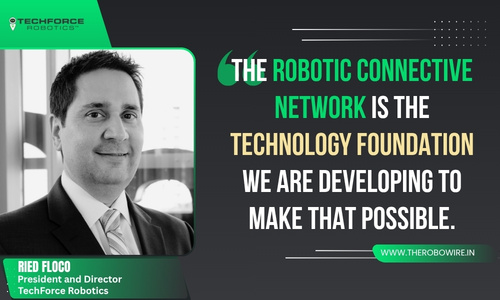
“We believe the future of autonomous robotics extends beyond individual machines performing isolated tasks,” said Ried Floco, President and Director of TechForce Robotics. “Our vision is an interconnected robotic workforce where specialized robots can communicate and coordinate activities across an entire facility. The Robotic Connective Network is the technology foundation we are developing to make that possible.”
To Know More About TechForce Robotics: CLICK HERE