


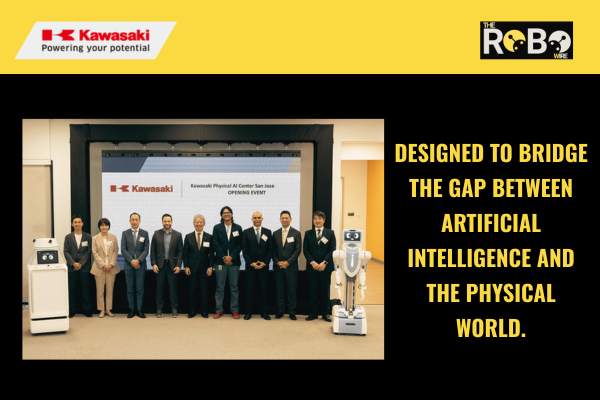
Kawasaki Heavy Industries has officially opened the doors to its new Physical AI Center in San Jose, California. The new Silicon Valley hub is designed to bridge the gap between artificial intelligence and the physical world, acting as a launchpad for a major US-Japan collaboration in AI and semiconductors.
To pull this off, Kawasaki has assembled a tech dream team, partnering with heavyweights like Nvidia, Microsoft, Analog Devices (ADI), and Fujitsu.
At the center’s opening ceremony on May 21, Kawasaki President and CEO Yasuhiko Hashimoto outlined the company’s vision, emphasizing that the goal isn’t to replace humans, but to support them.
“At the Kawasaki Physical AI Center, we will first focus on healthcare and elder care, where aging societies and labor shortages are global challenges,” Hashimoto said. He described a “hospital one-stop solution” where physical AI and robotics manage the entire patient experience from the moment they arrive at the hospital, through their exams, surgery, and post-op care.
“What matters most is that these solutions take root on site, are used continuously, and contribute to improving the quality of healthcare,” Hashimoto added. “What we aim for is not to replace people, but to deliver Physical AI that supports human judgment and action safely and efficiently.”
Why Kawasaki and Why Silicon Valley?
“Physical AI” refers to systems that can actually perceive, reason, and take physical action in the real world. To train AI models to do this safely, you need massive amounts of real-world operational data.
The company has decades of experience, drawn from its vast manufacturing empire that spans aerospace, shipbuilding, energy, and motorcycles.
By setting up shop in San Jose where Kawasaki already holds a massive market share selling robots for semiconductor manufacturing the company is placing itself at the epicenter of global tech talent.
The Japanese public multinational corporation manufacturer plans to combine its new AI software capabilities with its existing hardware lineup, which includes the autonomous service robot Nyokkey, the indoor delivery robot FORRO, the surgical robot system hinotori™, and the four-legged mobility vehicle CORLEO.
The Tech Dream Team To get these solutions out of the lab and into the real world, Kawasaki’s partners are taking on specific roles:
- Nvidia: Spearheading new solutions that blend AI and robotics, starting primarily in the healthcare sector.
- Analog Devices (ADI): Integrating advanced sensing and voice recognition tech so the robots can handle a wider, more complex variety of tasks.
- Microsoft: Providing the cloud and AI platform muscle needed to ensure these physical AI solutions are reliable and can scale up massively.
- Fujitsu: Tying it all together in the healthcare space by integrating robotic AI with existing hospital and business systems.
It will collaborate closely with Kawasaki’s domestic R&D bases in Japan, as well as the newly opened Kawasaki Innovation Centre Europe in Strasbourg, France, which just launched in March 2026. Together, these hubs will tailor Kawasaki’s physical AI solutions to meet the specific needs of different global markets, ensuring these advanced robots can seamlessly integrate into daily life.
To Know More – Click here