


HDDs continue to make up the majority of storage capacity in many data centers, especially as organizations plan for exabyte-scale environments and long-term retention.
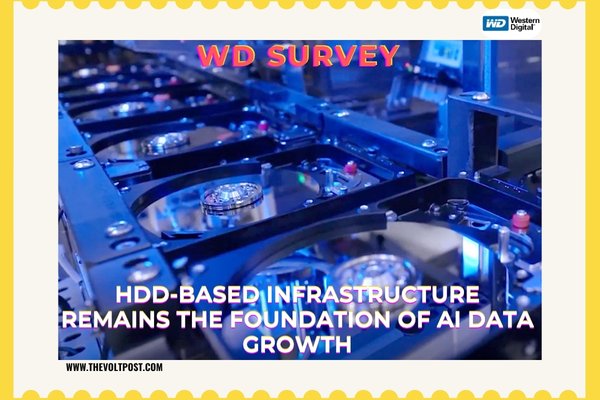
In a new survey of its largest global customers and distributors, Western Digital uncovered a clear market shift where enterprises are prioritizing infrastructure that delivers proven reliability, predictable economics, and the ability to scale data over time.
The findings highlight a structural change in AI infrastructure. While compute resources get reused across training and inference cycles, AI-generated data-training datasets, inference logs, embeddings, outputs keeps accumulating.
As organizations move from experimentation to production, AI infrastructure decisions are increasingly driven by long-term data retention and operational economics. This creates compounding storage demand that persists well beyond short-term compute cycles.
What the Survey Reveals
Proven Infrastructure Gains Favor
As AI deployments scale, companies are leaning toward operationally proven infrastructure.
-
66% of respondents say they’ve deprioritized or are considering deprioritizing newer technologies in favor of systems that deliver consistent reliability and predictable performance at scale.
Reliability and AI Workloads Share Top Priority
As AI scales, the focus shifts to throughput-driven infrastructure optimized for sustained data movement. Reliability, consistency, and efficiency now take precedence over raw latency.
-
69% prioritize supporting AI training and inference workloads
-
69% prioritize improving reliability and availability
-
Latency optimization ranked much lower (7%) compared to scalability, reliability, and operational efficiency
Capacity Expansion and Cost Efficiency Drive Planning
As AI data volumes keep growing, cost and capacity are central to long-term AI infrastructure strategy.
-
87% of respondents prioritize capacity expansion and total cost of ownership (TCO) optimization
Economics Drive Storage Decisions
Economics and scalability remain the primary drivers of large-scale storage architecture. This underscores the growing importance of tiered storage architectures that balance performance and cost across the AI data lifecycle.
-
74% cite TCO, capacity, and scalability as the main advantages of HDD-based infrastructure
HDD-Based Infrastructure Remains the Foundation of AI Data Growth
HDDs continue to make up the majority of storage capacity in many data centers, especially as organizations plan for exabyte-scale environments and long-term retention.
-
70% of respondents with visibility into their storage mix report HDD-majority infrastructure (more than 50% of total storage)
-
35% report environments where HDDs represent more than 75% of total capacity
“HDDs remain part of our long-term strategy because they deliver reliable, scalable storage at a lower cost, making them ideal for large data volumes and long-term retention,” said Abish Mohamed, Amstergi Middle East.
“HDD is not a legacy product; it’s a strategic capacity solution. It’s ideal for data growth and delivers the lowest cost per TB in the market. The future isn’t HDD vs. SSD—it’s HDD and SSD,” — Anonymous Survey Respondent
What This Means for AI Infrastructure
The survey shows that many organizations are building infrastructure to support continuous AI data systems not just discrete workloads or short-term experiments. AI infrastructure is increasingly being designed as a long-lived data system, not just a high-performance compute environment.
“AI is fundamentally a data systems challenge, not just a compute challenge. Our customers are on the front lines solving it, and their needs directly shape our innovation roadmap and the technologies we build for the AI era and beyond,” said Ahmed Shihab, Chief Product Officer at WD. “While compute is reused, data persists—and grows. The organizations that win in the next phase of AI will be the ones that build infrastructure designed for continuous data systems at scale, not just peak compute performance.”
“HDDs stay in a long-term strategy because they solve a problem newer technologies still can’t beat on economics and scale. In simple terms: they’re the cheapest, most reliable way to store huge amounts of data for a long time. Even as SSDs dominate performance-critical workloads, HDDs remain unmatched for bulk storage,” — Anonymous Survey Respondent
 Survey Methodology
The findings are based on a Western Digital survey of 200 top global customers across hyperscale cloud, CSP, and enterprise segments, conducted in 2026. Eighty respondents represented organizations responsible for enterprise infrastructure strategy, data center operations, and storage architecture. Individual survey questions received varying response totals.
To Know More: CLICK HERE