


FANUC America is set to highlight the next wave of intelligent automation at Automate 2026, bringing together advanced robotics, collaborative systems, and AI-driven manufacturing technologies at McCormick Place in Chicago from June 22–26.
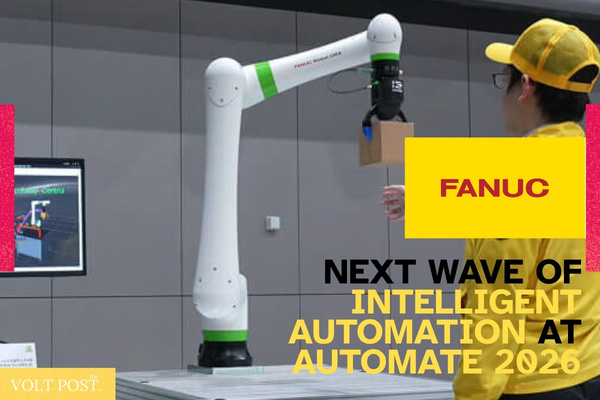
At Booth 1401, the company will run live demonstrations spanning collaborative robots, high-payload industrial systems, vision-guided automation, and emerging AI capabilities designed to improve flexibility, precision, and scalability across manufacturing environments.
The showcase at Automate 2026 centers on real-world applications, with FANUC demonstrating how AI, 3D vision, and simulation tools are being used to solve practical production challenges.
Many of these systems integrate technologies such as NVIDIA Jetson edge computing, NVIDIA Isaac Sim for digital twin simulation, and ROS 2 for flexible system integration enabling faster deployment and more adaptive automation.
One of the standout debuts is the CRX?3iA collaborative robot, designed for vertical-up welding an application that has traditionally been difficult to automate. Using a newly developed welding profile, the robot compensates for weld pool sag and mirrors the precision of a skilled welder.
Its lightweight design (just 11 kg) allows operators to position it directly on large structures, such as I-beams, using a magnetic base, with touch sensing guiding accurate weld placement.
FANUC is also showcasing a CRX-20iA/L cobot performing real-time bolt tightening on a moving engine block.
Powered by Inbolt Physical AI and NVIDIA-based processing, the system tracks parts in motion and completes assembly tasks without stopping the line demonstrating how AI-driven perception enables continuous production.
For food and packaging environments, the FANUC M-710 Series Robot – Medium Payload Robots handles palletizing and depalletizing, supported by PalletTool software and an NVIDIA Isaac Sim digital twin. This setup gives manufacturers a clear view of how simulation can streamline cell design and commissioning while meeting industry-specific requirements.
Human-robot collaboration is another key focus. The CRX-10iA/L demonstrates vision-guided box handling and barcode scanning, using RGB-D cameras and AI-based tracking to detect nearby operators and adjust motion in real time maintaining both safety and productivity in packaging and logistics workflows.
FANUC is also introducing its next-generation R-2000/E Series robots, built for high-payload applications like automotive spot welding and material handling. With faster axis speeds, higher wrist capacity, and a more compact footprint, the series is engineered to deliver better performance without increasing system complexity.
High-speed assembly is covered by the SR-9iA/R SCARA Robot, which performs circular conveyor tracking using iRVision® 3DV technology. The compact system handles precise pick-and-place operations and tool changes, making it well-suited for medical, packaging, and high-throughput assembly lines.
In one of the more forward-looking demos, a CRX-20iA/L cobot is programmed using generative AI. Through natural-language input, spoken commands are converted into executable robot actions via AI-generated Python code highlighting how generative AI could simplify robot programming and reduce setup time.
Rounding out the lineup, the P?55/15?21A paint robot demonstrates advanced coating automation with integrated line tracking. Equipped with PaintTool software and high-efficiency applicators, it delivers consistent finishes on moving parts.
The system also features the new R-50iA controller, which consolidates functions into a single cabinet and simplifies system design by eliminating battery-dependent encoders.
Beyond individual demos, FANUC will showcase its full collaborative robot lineup in motion, along with digital tools such as Zero Down Time (ZDT) cloud connectivity for live monitoring and analytics. Company experts will also take part in keynote sessions and panel discussions throughout the event, offering deeper insight into the future of AI-driven automation.
With Life Metrics Click, developers get a versatile platform for multi-parameter vital sign monitoring, making it well-suited for wearable devices, biomedical systems, and health-focused embedded applications.
The board’s flexibility across use cases ranging from fitness and wellness tracking to medical research and real-time biometric sensing. He also pointed to the company’s expanding ecosystem, which now includes more than 665 sensor Click boards and over 875 ready-to-use projects available on EmbeddedWiki.
At the core of the board is the AS7058A multi-vital sign analog front-end from ams OSRAM, paired with the SFH 7074 optical sensor. This combination enables a broad set of measurements, including photoplethysmography (PPG), electrocardiogram (ECG), bioelectrical impedance (BioZ), and electrodermal activity (EDA).
 Additional sensing capabilities round out the platform, with temperature monitoring handled by the AS6223A and motion tracking via the LIS2DH12 three-axis accelerometer. Dedicated ECG connectors, interrupt signaling, a low-noise 1.8V architecture, and bidirectional level shifting ensure stable performance and straightforward integration over an I2C interface.
Life Metrics Click joins MIKROE’s extensive portfolio of mikroBUS™-enabled boards, now numbering over 1,975.
It also supports the ClickID feature, allowing host systems to automatically detect and configure the board. Combined with support for the mikroSDK open-source libraries, the platform gives developers a flexible starting point for evaluation, prototyping, and customization.